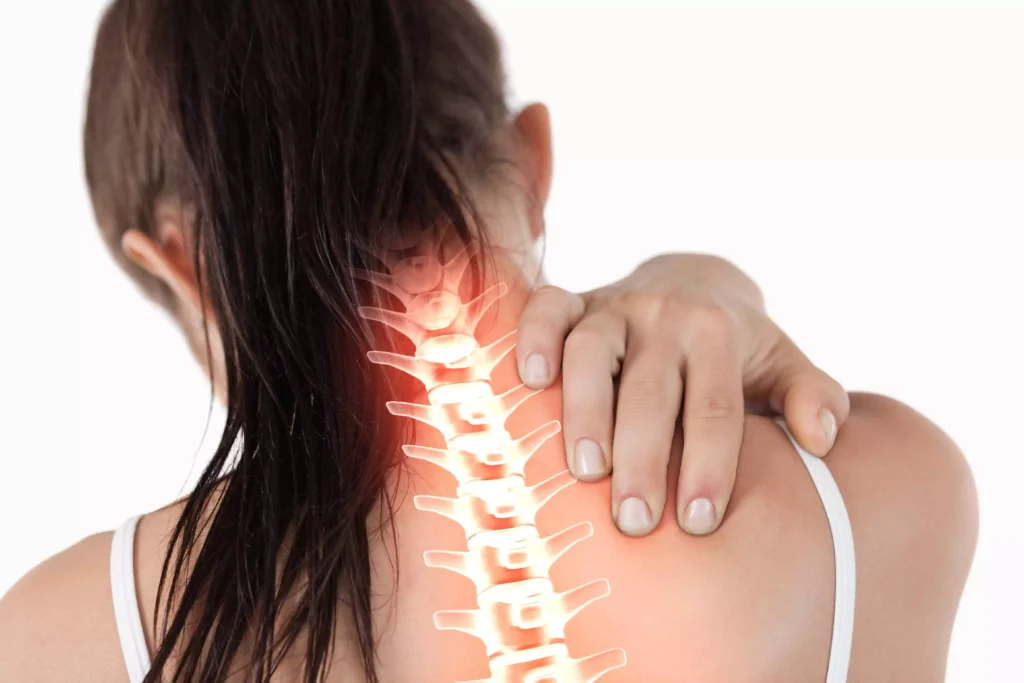
Cervical Disc Herniation (Cervical Disc Herniation)
One of the most common causes of neck pain is a cervical disc herniation. There are 7 vertebrae in the neck. The spine is responsible for protecting the spinal cord while allowing us to stand upright. The neck region also controls the nerves of the hands, arms and upper body.
Contents
What are the causes of cervical disc herniation?
What are the symptoms of cervical disc herniation?
How to Diagnose Cervical Disc Herniation?
What are the Treatment Methods for Cervical Disc Herniation?
The vertebrae that make up the spine are connected to each other by two joints. One of these is the discs and the other is the facet joint. There is a gel-like fluid in the middle of the discs and the outer part consists of a hard connective tissue. The discs act as cushions, minimizing the impacts that occur while moving and preventing damage to the spinal cord, while providing mobility to the spine.
Cervical disc herniation occurs as a result of damage (hernia) to one or more of the 7 vertebrae in the cervical region, which is the uppermost part of the spine consisting of three parts (cervical, thoracic, lumbar).
Fluid loss may occur in the gel-like structure in the center of the disc as a result of aging or trauma. This fluid loss can also cause loss of function in the discs. Likewise, as a result of deterioration in the outer tissue of the disc or the gel structure inside the disc overflowing into the canal where the spinal cord is located, disc herniation, in other words hernia, may occur.
WHAT ARE THE CAUSES OF CERVICAL HERNIA?
It is difficult to determine the cause of cervical disc herniation. Some of the patients can survive without realizing that they have a hernia. While hernias can occur on their own over time without any trauma, traffic accidents, falling from a high place, working in front of the computer for a long time, using the mobile phone with the neck bent forward, using the phone below eye level, sudden movements, and wrong movements while lifting weights can also cause cervical disc herniation.
WHAT ARE THE SYMPTOMS OF CERVICAL HERNIA?
Patients often consult a doctor with complaints of neck and arm pain. The part of the disc protruding from the inside of the disc puts pressure on the nerve root from the spinal canal, resulting in pain in the neck and arm. This is a situation that negatively affects the quality of life. Apart from this, there may be weakness and sensory deficits in the arm and hand as a result of pressure on the nerves going to the arm. If precautions are not taken and the discs put pressure on the spinal cord, more serious complications may occur:
Stumbling while walking and impaired walking posture
Sensation of electric shock or tingling all over the body towards the legs
Decline in fine motor skills in the hands
Loss of balance and coordination
sensory loss
thinning in the arm
Weakening of reflexes
HOW IS CERVICAL HERNIA DIAGNOSED?
The diagnosis of cervical disc herniation is usually made as a result of a physical examination of patients presenting with pain. The time of onset of the pain, its character and places of spread are among the factors that facilitate diagnosis. An examination to understand the muscle strength, sensation and reflexes in the arms and hands is also necessary for a definitive diagnosis.
However, imaging techniques are also used to understand exactly where the pressure is or whether there is another cause of the pain. X-ray, myelography, computed tomography (CT) and MRI are used for definitive diagnosis.
While x-ray reveals the general condition of the spine, computed tomography can detect pressures related to the structure of the spine and bone pathologies. MRI allows imaging of the spine, spinal cord and its surroundings. Through MRI, it can also be determined which disc is compressing, deteriorations in the structure of the disc and which nerves are compressed. EMG method is used to understand whether the nerves are damaged or not. Thanks to small electrical currents sent to the nerves, it is possible to detect damage to the nerves using this method.
WHAT ARE THE TREATMENT METHODS FOR CURRENT HERNIA?
Cervical disc herniations can often heal without the need for surgical intervention. Anti-inflammatory analgesic drugs, exercise and epidural steroid injection to reduce edema are recommended in the treatment of cervical disc herniation. The aim here is to reduce the pressure of the material in the internal structure of the disc on the nerves and relieve pain. Thus, the patient's quality of life will increase.
In the treatment of hernia, the patient is advised to rest first. It can be said that resting for a day or two and avoiding exercise during this period is useful to relieve the pain in the area, which also accelerates the recovery process of the patient. In some cases, bed rest is also recommended for the patient. However, since it would be harmful for the area to remain motionless for a long time, the rest should not last more than a day or two.
Medication
Apart from the methods listed above, if there is pain that makes daily life difficult for the person, this situation can be alleviated with painkillers. However, painkillers should not be used for a long time without consulting a doctor, and at this point it should not be forgotten that painkillers do not have therapeutic properties. If symptoms such as persistent neck pain, limitation of movements and tingling in the hands and arms are observed, a doctor should be consulted and the necessary treatment process should be initiated.
The medications used in the treatment of cervical disc herniation also include a group of painkillers called analgesics. Doctors may indicate that muscle relaxants should also be used in some cases. If there is intense and persistent pain, the patient may be given more effective medications to use for a short time. It should not be forgotten that long-term use of such drugs has side effects such as insomnia, stomach bleeding, and kidney problems. Additionally, the patient may need to have an allergy test before starting such medications.
Other treatment methods
Part of the treatment of cervical disc herniation is physical therapy. Physical therapy is a type of treatment that includes many different applications. Within the scope of this treatment, methods such as stretching exercises, cardio exercises performed in a fixed position such as an exercise bike, massage, ultrasound and electrical muscle stimulation are used.
However, if there is no relief or reduction in the patient's symptoms, other treatment options may be considered. Chief among these are steroid injections around the hernia to relieve pain and edema.
Epidural injections are one of the methods used for intense arm pain. These injections, made outside the spinal cord or around the nerve roots, are made by applying corticosteroids and local anesthetic. Multiple injections may be required on different dates to minimize or completely eliminate symptoms. The purpose of the injection is to reduce edema and inflammation in the area.
Surgical Methods
Surgical intervention may be necessary for patients with persistent pain, loss of strength and spinal cord compression. This surgical intervention is called discectomy. This method is a method in which the part of the disc that puts pressure on the spinal cord and nerve is eliminated. The surgery is performed by making a small incision in the front of the neck or at the nape of the neck. Where the surgery will be performed depends on the location of the hernia, the content of the surgery, and the doctor's preference.
Like all surgical interventions, this intervention has various risks of complications. These risks include postoperative bleeding, spinal cord damage, nerve damage or infection. In surgeries performed on the front, that is, the neck area, conditions such as hoarseness and difficulty in swallowing may also occur. The hernia may recur in some patients due to their general health condition, family history and post-operative life choices. Recurrent hernias can occur between the same or different vertebrae.
After the surgery, patients can be discharged in as little as 24 hours and can gradually return to their daily activities.
This information is educational and does not replace consultation with a physician.