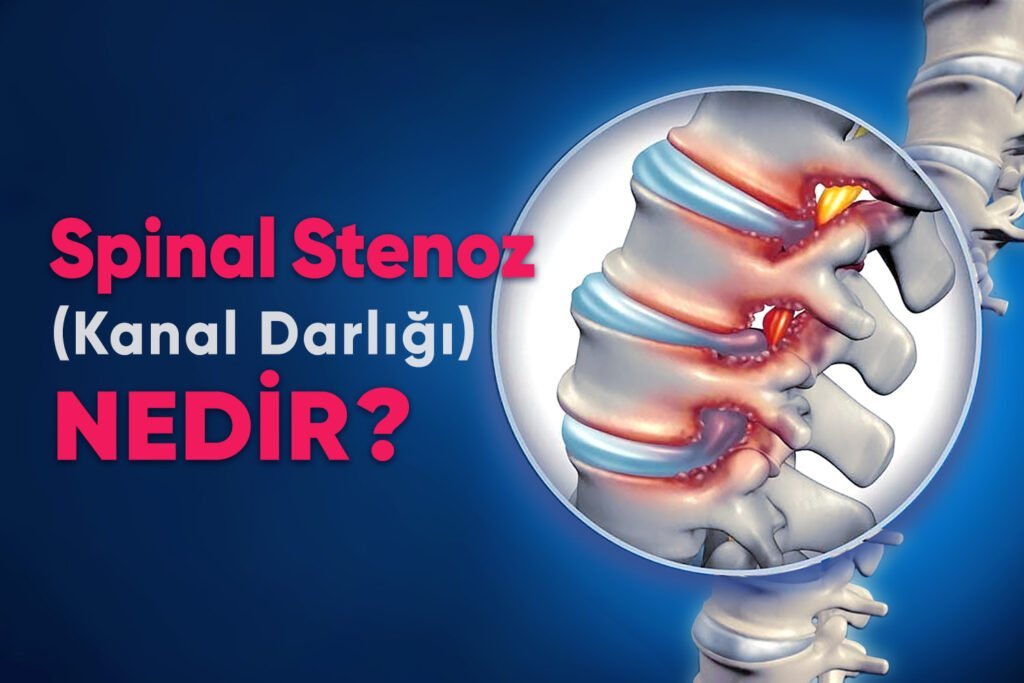
With advancing age, the discs between the vertebrae lose their spongy structure and begin to contain less water. This event causes the disc height to decrease and the hardened disc to curve towards the spinal canal. The spinal cord carries nerves that provide sensation and strength to the legs. Due to arthritis (destruction of cartilage tissue), the bones and ligaments of the facet joints in the spine thicken and put pressure on the spinal canal. These changes cause narrowing of the lumbar spinal canal, and this condition is called lumbar stenosis (spinal stenosis).
Lumbar stenosis can be compared to the accumulation of lime inside a garden hose over time. (Figure-1) Just as limescale narrows the diameter of the tube over time, the narrow canal similarly narrows the diameter of the spinal canal.
The lumbar spine consists of a series of interconnected bones called vertebrae. Bones surround the spinal canal, which runs between the vertebrae through which the spinal cord passes. Other structures that form the borders of the spinal canal are intervertebral discs, facet joints and connective tissues between the vertebrae.
WHAT ARE THE SYMPTOMS OF LUMBAR Narrow CANAL?
Lumbar stenosis may not always cause complaints in the person. However, pain or loss of sensation in the back; pain, cramps, numbness, weakness in the legs; Complaints such as urinary incontinence may also occur. Complaints may increase due to sitting or standing for long periods of time. Existing complaints may come and go and continue with varying severity over time. Leaning forward or sitting can increase the diameter of the spinal canal, thus reducing or completely eliminating the pain.
The most typical complaints of patients are weakness in their legs after walking a certain distance, changes in sensation, numbness and tingling, and the fact that their legs can no longer take a step. In this case, patients must look for a place to sit. By sitting down and leaning forward a little, the legs regain strength and they start walking again. However, after a certain distance, the complaints recur and the need to sit again arises.
HOW IS LUMBAR Narrow CANAL DIAGNOSED?
First of all, you should provide detailed information about your complaints to your doctor's questions. X-rays can be taken to look for narrowed disc spaces or thickened facet joints. Thanks to magnetic resonance imaging (MRI), extremely detailed information can be obtained about the stenosis in the spinal canal and the compression of the spinal cord. Computed tomography (CT) or lumbar myelogram can also be used to obtain detailed images. Each of these studies can provide information about the presence, location and severity of spinal canal stenosis and nerve root compression.
WHAT ARE THE TREATMENT METHODS FOR LUMBAR Narrow CANAL?
After your doctor diagnoses lumbar stenosis as the cause of the pain, he will first try non-surgical treatments.
WHAT ARE THE NON-SURGICAL TREATMENT METHODS FOR LUMBAR Narrow CANAL?
Non-surgical treatments for lumbar stenosis include anti-inflammatory drugs or painkillers that reduce inflammation. Physical therapy options may also be considered to facilitate your daily activities by maintaining and increasing your flexibility, strength and conditioning. Spinal injections (epidural cortisone injections) may also be recommended.
MEDICAL TREATMENT METHOD IN LUMBAR Narrow CANAL
One or more medications may be prescribed by your doctor to reduce symptoms and complaints and increase your mobility. Medicines used to control pain are called analgesics. In most cases, the pain responds to commonly used (over-the-counter) painkillers such as aspirin or acetaminophen.
Some analgesics called non-steroidal anti-inflammatory drugs (NSAIDs) may be added to control any irritation and inflammation that may occur. These include various medications containing the active ingredient ibuprofen, naproxen and available by prescription. If your doctor prescribes painkillers or anti-inflammatory medications, you should be careful about side effects such as stomach upset or bleeding. You should be monitored by your doctor for problems that may arise from long-term use of prescription or over-the-counter painkillers and NSAIDs.
If you have severe and persistent pain that does not benefit from other analgesics or NSAIDs, your doctor may also prescribe narcotic analgesics (such as codeine) for a short time. You should only use the recommended amount of medication. Taking a higher dose will not speed up your recovery. High doses of medication may cause nausea, constipation, dizziness and imbalance, and may cause addiction. All medications should be taken only as prescribed. Tell your doctor about any medications you use (including those you took without a prescription), and if he or she recommends painkillers, and if you have used these medications before, tell them whether they worked for you and their side effects.
Other medications with anti-inflammatory effects are also available. Corticosteroid medications (in tablet or injection form) are sometimes prescribed for very severe back and leg pain due to their strong anti-inflammatory effects. Like NSAIDs, corticosteroids can have side effects. You should discuss the benefits and risks of these medications with your doctor.
Selective spinal injections, or “blocks,” can be used to relieve very severe pain. These are corticosteroid injections into the epidural space (the space around the spinal nerves) or facet joints, performed by a doctor trained in this technique. Depending on the response to treatment, the first injection may be supplemented with one or two injections at a later date. These are generally done within the scope of a rehabilitation and treatment program.
LUMBAR Narrow CANAL SURGERY
People with lumbar stenosis complaints generally avoid activities. This condition can also lead to decreased mobility, flexibility, strength and cardiovascular fitness. This condition can be improved with a physical therapy or exercise program. Physical therapy and exercise programs usually begin with stretching exercises to make tight muscles flexible again. You may be asked to repeat stretching exercises frequently to maintain your flexibility.
Cardiovascular exercises such as exercise bikes, treadmills and swimming can be added to the program to increase fitness and improve blood circulation in the nerves. Increasing blood flow in the nerves can reduce some narrow canal complaints. Additionally, exercises to strengthen the back, abdominal and leg muscles can be given.
If your flexibility, strength and conditioning are maintained and increased, your daily activities will become easier. Your physiotherapist or doctor can tell you that you can add a continuous exercise program to your life by using simple equipment at home or by going to a sports center.
For some people with lumbar stenosis, home modifications and home safety are important. Home appliances such as washing machines may need to be moved to more useful locations. A nightstand next to the bed may be useful. If necessary, safety devices to prevent falls in the bathroom are also recommended. Plans for meal preparation, scheduling activities, and saving work should be reviewed. It is important that any necessary equipment, such as canes or walkers, fits the patient properly. The presence of a stenosis does not create a dangerous situation in adults unless there is significant or increasing weakness in the legs or bowel and bladder control problems. Therefore, the aim of the treatment is to reduce pain and increase the patient's functionality.
Nonsurgical treatments do not correct narrowing in the spinal canal, but they provide long-term pain control and increased functionality without the need for surgery. A participatory rehabilitation program requires supervised treatment lasting three months or more.
WHEN IS SURGICAL TREATMENT REQUIRED FOR LUMBAR Narrow Canal?
Surgery for lumbar stenosis is recommended for patients whose pain and complaints cannot be relieved with non-surgical treatment methods and whose functions such as walking and movement are seriously damaged.
Surgical treatment for lumbar stenosis patients is also applied to people with progressive leg weakness or bladder and bowel control problems. At the same time, surgical treatment can be considered a good option in patients whose walking distance becomes shorter and their quality of life decreases. Rehabilitation support should also be received to make the transition to daily life more comfortable after the surgery.
SPINAL FUSION TREATMENT IN LUMBAR Narrow CANAL
In cases of stenosis, the vertebrae may sometimes slide over each other (spondylolisthesis). In some cases, scoliosis (sideways curvature) may have developed in the waist. In this case, abnormal movements (instability) may occur between the vertebrae. In such cases, in addition to decompression surgery, spinal fusion surgery may also be performed to identify the relevant vertebrae. It can be done by placing bone pieces, bone-like substances or metal tools (instrumentation) between the relevant vertebrae to be fixed by fusion. (figure-2)
Fusion can be performed using an anterior or posterior approach or both approaches together. The choice of approach (anterior/posterior) in fusion surgery is determined by many technical factors such as the need to remove bony prominences, the location of the protrusions, anatomical differences between patients, and the degree of instability.
In most lumbar stenosis patients, pain decreases after surgery and a significant improvement and increase in all activities is observed 6 to 9 months after surgery. A rehabilitation program is usually started after surgery to return to daily activities and a normal life.
This information is educational and does not replace consultation with a physician.