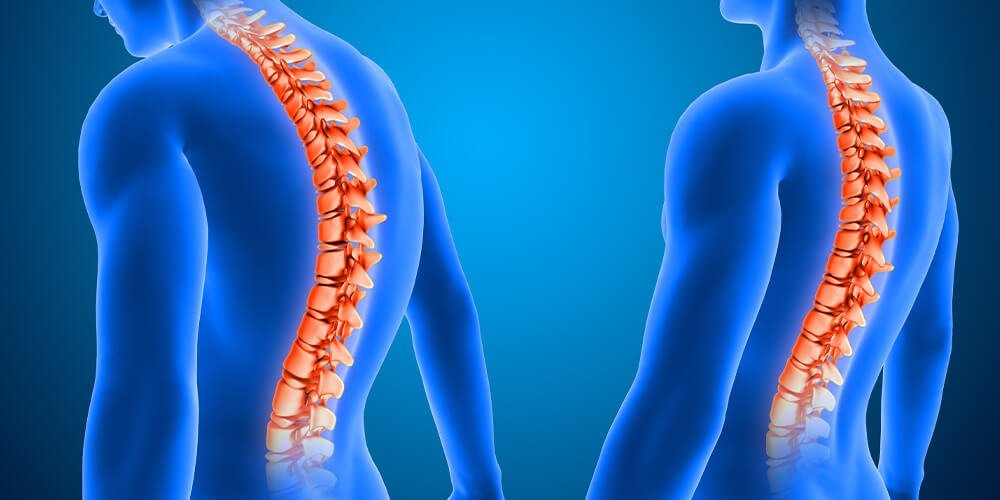
WHAT IS SCOLIOS?
Situations in which the normal curvature of the spine is disrupted are defined as scoliosis. In scoliosis, the external appearance of the spine can be compared to the letter S or C. Sideways curvature in the structure of the spine usually occurs in pre-adolescence and early adolescence. It is estimated that 3 out of every 100 adolescents have this disorder. In 4 out of every 5 scoliosis patients, the underlying cause cannot be clarified.
WHAT ARE THE TYPES OF SCOLIOSIS?
In the medical literature, these diseases are defined as idiopathic when most of the factors that cause the disease cannot be determined with certainty. Therefore, the most common type of scoliosis is referred to as "idiopathic scoliosis". Idiopathic scoliosis is divided into 4 separate groups with age limits ranging from 0 to 18.
While the term Infant idiopathic scoliosis is used for patients between the ages of 0 and 3, patients between the ages of 4 and 10 are classified as juvenile idiopathic scoliosis, scoliosis patients between the ages of 11 and 18 are classified as adolescent idiopathic scoliosis, and scoliosis cases detected after the age of 18 are classified as adult idiopathic scoliosis. Considering the age group in which the disorder is most common, it can be concluded that the majority of scoliosis patients are people diagnosed with adolescent idiopathic scoliosis.
Scoliosis detected after birth is classified as congenital scoliosis. This is a type of scoliosis that can also be detected during ultrasonographic (USG) examinations performed while the baby is still in the womb. This condition, which occurs due to a problem occurring during the development of the skeletal structure of the spine, may be accompanied by a developmental defect related to other systems that develop simultaneously, such as the nervous, excretory and cardiovascular systems.
WHAT ARE THE CAUSES OF SCOLIOSIS?
The actual cause cannot be determined in the majority of scoliosis patients, but the presence of family members with the same condition in 1 out of every 3 scoliosis patients may indicate a genetic transmission. For this reason, it is important for parents who were diagnosed with idiopathic scoliosis in their youth to be aware that their children may also develop this condition.
WHAT ARE THE SYMPTOMS OF SCOLIOSIS?
The symptoms of scoliosis vary with the degree of curvature of the spine. Various signs and symptoms may contribute to the recognition of this disorder:
Shoulders, shoulder blades and pelvic bones that are not in equal alignment when viewed from the outside
One of the two hips appearing higher
Sideways curvature of the spine
Neck, back and waist pain that persists for a long time
At the same time, due to this change in the spine, the volume of the rib cage decreases. The reduced rib cage volume may prevent the lungs from expanding sufficiently during inhalation and exhalation, causing breathing complaints.
HOW IS SCOLIOSIS DIAGNOSED?
For the purpose of scoliosis diagnosis, first of all, the diseases that are known to cause scoliosis, although rare, are investigated. Determining the cause of scoliosis is especially important in the presence of scoliosis that begins at an age younger than 10 years, in cases where the curvature progresses rapidly, and in the presence of symptoms related to the nervous system.
During the examination, the skeletal system of the person with the disease is evaluated. Persistent back pain may be among the complaints of scoliosis patients (approximately one quarter of the patients), but the majority of the patients are individuals in their age group who participate in athletic activities and do not have any other disease other than scoliosis.
The presence of scoliosis can be revealed through various radiological examinations. X-ray radiographs taken from various angles with relatively low radiation exposure are the first imaging method used. If deemed necessary by the physician, other imaging methods such as magnetic resonance imaging and computed tomography can also be used for diagnostic purposes.
The degree of curvature of the spine is evaluated with imaging methods. In order for the person to have scoliosis, the curvature must be at least 10 degrees.
HOW IS SCOLIOSIS TREATMENT?
Procedures such as bracing and surgical intervention are extremely rare in the treatment of scoliosis. The principle of treatment is observation, appropriate exercise and sports activities and follow-up. Although many factors are taken into consideration in treatment planning, the degree of curvature is one step ahead among these factors. In patients diagnosed with adolescent idiopathic scoliosis but without any treatment intervention, the curvature may increase by an average of 0.5-1 degree per year. In addition, in cases of scoliosis that occur during adolescence, curvatures tend to have a worse course than scoliosis seen at early ages. For this reason, more aggressive surgical interventions may be needed in older age scoliosis cases compared to adolescent scoliosis.
Untreated scoliosis patients may experience waist and back pain, nerve damage, and various problems involving organs such as the lungs and heart in later stages. In addition to these problems, negative thoughts about one's own appearance are also an issue that should be considered during treatment planning.
In people whose degree of curvature detected in the spine is between 10 and 25 degrees, it is recommended to continue follow-up and evaluation with x-rays taken at intervals of 3, 6 and 1 year. For curves greater than 25 degrees but not reaching 40-45 degrees, the bracing method called orthosis can be tried if deemed appropriate by the physician. The use of orthosis, a corset-like structure, aims to prevent the progression of spinal curvature, but this method has been used very rarely in recent years.
In some cases detected early, this bracing method may come to the fore in treatment planning. Orthoses must be worn 16-23 hours a day during the growth period. Regular use is an important issue in orthosis treatment.
In people whose spine curvature exceeds 40 degrees, spinal correction through surgical intervention may be considered. In a technique called spinal fusion surgery, the bones that make up the spine are combined using structures such as long rods, bone grafts and screws to correct scoliosis. While the rods allow the spine to be straightened, this structure is fixed with screws. The structure is strengthened with the bone tissue used. In children whose growth and development continues, readjustment of the rod and screw structures may come to the fore over time.
As a result, in the majority of patients diagnosed with scoliosis, appropriate exercise, appropriate sports activities and follow-up form the backbone of the treatment, just like the scoliosis itself.
This information is educational and does not replace consultation with a physician.